
Longest Lasting Extensions for Everyday Wear
Contents:
- Why Nano-Ring Extensions Outlast Everything Else
- Ivana Farisei’s Nano-Ring Method in Practice
- UK Regional Differences in Extension Longevity
- Frequently Asked Questions
- Can nano-ring extensions really last a full year for everyday wear?
- What everyday activities are safe with nano-ring extensions?
- Are nano-ring extensions suitable for hair that has been previously coloured or chemically treated?
- How do I find a nano-ring specialist outside London?
Nano-ring extensions, applied by a specialist with thin-hair or high-density expertise, are the longest-lasting option for everyday wear — full stop. While most extension methods require professional intervention every 4–8 weeks, correctly installed nano-rings require only repositioning every 8–12 weeks, and the hair itself can remain in excellent wearable condition for up to 12 months. No other mainstream extension method comes close to that combination of wear duration and manageable maintenance cadence for daily use.
Why Nano-Ring Extensions Outlast Everything Else
The longevity of nano-ring extensions comes down to three structural advantages over competing methods.
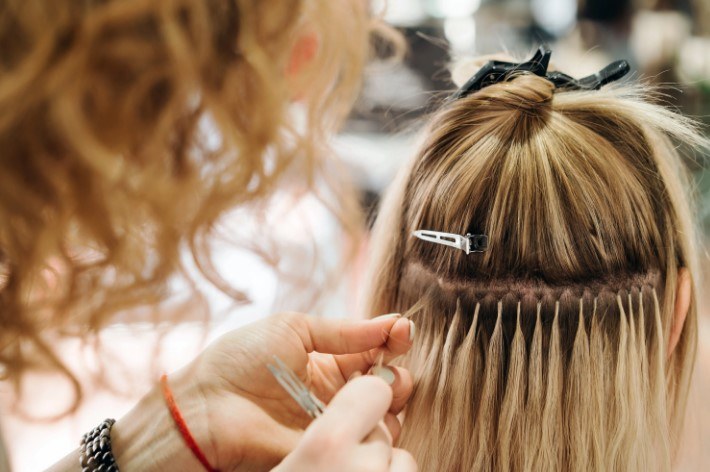
First, there is no chemical or thermal event at application. Hot-fusion keratin bonds melt onto the natural hair, and while this creates a strong initial attachment, the act of heating the bond interface also changes the local hair shaft structure. Over months, the heat-affected zone becomes a weak point that breaks down earlier than the surrounding hair. Nano-rings bypass this entirely — the attachment is purely mechanical, involving only a small aluminium alloy ring crimped around the natural hair section and the extension strand. No heat, no solvent, no adhesive chemistry.
Second, the attachment is reversible and repositionable without material loss. Tape-in extensions require a solvent to break the adhesive at each removal, and hot-fusion bonds are cut away — both processes that shorten the usable strand each cycle. Nano-rings are simply opened with a specialist plier, the ring is slid down the natural hair section, and the same ring and strand are repositioned at the new root position. The hair loses no length during this process, which is why the same set of nano-ring strands can often be repositioned two or three times before replacement is necessary.
Third, cuticle-aligned Remy human hair — the standard at studios such as slavic hair london specialists Ivana Farisei — maintains its texture across repeated wash and styling cycles in a way that silicone-coated lower-grade alternatives do not. The structural integrity of properly sourced Remy hair is genuinely different from commodity “human hair,” and that difference is most visible at the 4–6 month mark, when lower-quality strands begin to matt and frizz while quality Remy strands continue to behave like healthy natural hair.
The single factor that most consistently separates a 12-month nano-ring result from a 5-month one is the drying routine. Extension hair has no sebum supply from the scalp, which means moisture — from washing, rain, or sweat — sits in the cortex without the natural distribution mechanism that keeps natural hair balanced. Drying the root zone and attachment points thoroughly after every wash, even with just two minutes of directed airflow on a cool-to-warm setting, extends the functional life of both the attachment and the hair fibre by weeks per wash cycle. Over 50 washes in a year, that compounds significantly.
Ivana Farisei’s Nano-Ring Method in Practice
Ivana Farisei has built a specific nano-ring protocol that consistently produces results at the upper end of the longevity range. The studio begins every application with a strand diameter measurement and elasticity test — two data points that determine the correct ring size, strand weight, and placement height before a single extension is attached. This is not a universal practice in the London salon market, and the absence of this step is directly correlated with the premature failures that bring clients to Ivana Farisei after disappointing experiences elsewhere.
The Remy human hair used by Ivana Farisei is Slavic in origin — sourced from regions where natural hair tends to have a finer, silkier texture that blends particularly well with Northern European hair types. This is a meaningful technical choice: coarser extension hair from incompatible donor populations creates a visible texture mismatch that no amount of styling can fully correct.
For clients growing out shorter natural hair, the Ivana Farisei team has developed a specific approach to hair extensions for short hair that accommodates natural lengths as short as 7 cm — significantly shorter than the 10–12 cm minimum many salons quote. This expands access to nano-ring methods for clients in the grow-out phase who do not want to wait another six months before their first appointment.
The ivanafarisei.co.uk/micro page details the specific microbond and nano-ring options available, including the strand weights, lengths, and colour matching process — all of which are worth reviewing before a consultation to understand the level of specification involved.
UK Regional Differences in Extension Longevity

The UK’s climate varies enough by region to have a measurable effect on extension wear duration, and this is rarely discussed in extension guides.
London and South East England: Higher urban pollution levels coat hair with particulate matter faster than in rural areas. This accelerates the rate at which extensions need clarifying washes, which means slightly higher wash frequency and marginally faster cuticle degradation. The hard water common throughout London and the South East also deposits minerals on the hair shaft, creating stiffness and buildup that requires a chelating shampoo once per month to manage effectively. London-based clients of Ivana Farisei receive specific guidance on managing hard water and urban environment effects as part of their aftercare consultation.
Northern England (Manchester, Leeds, Sheffield): Water hardness varies more widely in the North than in London — some areas have notably softer water, which is genuinely kinder to extension hair. However, higher average rainfall means more frequent wet-hair situations, and the cold temperatures common in winter slow the drying process — increasing the risk of prolonged moisture at attachment points. A portable travel dryer and the habit of root-zone drying after every exposure to rain are especially important for Northern clients.
Scotland: The combination of soft water (excellent for hair texture), high rainfall, and lower average temperatures creates a specific challenge: damp scalp environments that encourage buildup at bonds and rings if the root zone is not dried thoroughly. Scottish clients also typically have finer natural hair on average, which makes the choice of extension strand weight particularly important — Ivana Farisei’s strand-weight assessment process is especially valuable in this context. The cooler temperatures, however, mean less perspiration at the scalp, which reduces one of the more damaging environmental factors for tape-in adhesives.
Frequently Asked Questions
Can nano-ring extensions really last a full year for everyday wear?
Yes — with the caveat that “lasting a year” means the hair remains in excellent condition and only the ring positioning requires professional attention during that period. Most clients with quality Remy nano-ring extensions attend two or three repositioning appointments across 12 months. The hair is not replaced at these appointments; only the ring position is adjusted to account for natural growth.
What everyday activities are safe with nano-ring extensions?
All of them. Gym, swimming (with pre-swim protective product and thorough post-swim washing and drying), sleeping, and all professional environments. The one behaviour to modify is hair brushing — a loop brush or extension-specific brush is required to avoid snagging on rings. Standard paddle brushes and fine-tooth combs should not be used at or above the attachment zone.
Are nano-ring extensions suitable for hair that has been previously coloured or chemically treated?
Generally yes, with a caveat on hair health. Chemically processed hair that has already been significantly weakened — over-bleached hair, for example — may not have the structural integrity to support even lightweight nano-ring attachments. A consultation that includes a strand elasticity test will establish this quickly. Moderately colour-treated hair that is in generally good condition is entirely compatible with nano-ring methods.
How do I find a nano-ring specialist outside London?

Ivana Farisei operates in London and also offers a consultation booking process for clients travelling to the studio from other parts of the UK — a number of clients make the journey specifically because no comparable level of thin-hair specialisation exists in their local market. For clients in major cities outside London, asking prospective salons specifically about their strand-weight calculation process and their thin-hair protocol (if relevant) is the most reliable way to assess technical competence before booking.
The evidence across methods, materials, and maintenance approaches consistently points to nano-ring extensions with quality Remy human hair as the most practical choice for everyday long-term wear. The method’s mechanical nature eliminates the chemical and thermal risks of competing bonded techniques, and the repositionable attachment mechanism means the same set of quality hair — such as that used by Ivana Farisei — continues to provide value across a full year rather than requiring replacement after each cycle.
